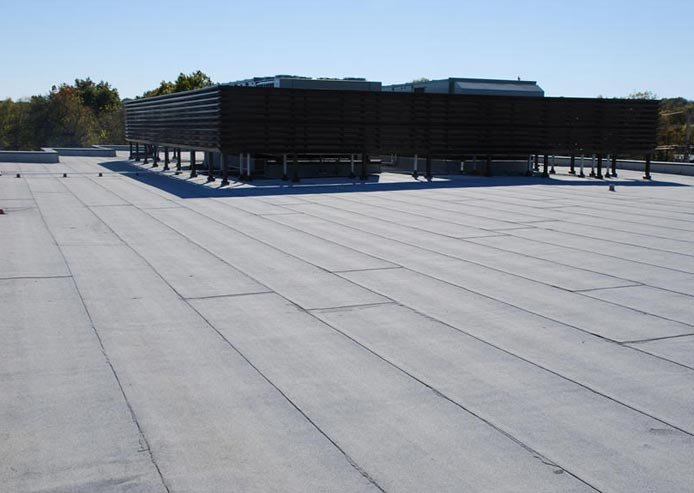
If you own or manage a commercial property with a low-slope roof, you’ve probably encountered several roofing systems that seem similar at first glance. BUR Roofing, short for built-up roofing, takes a distinctly different approach. Instead of relying on one primary membrane layer, BUR creates waterproofing through multiple reinforcing plies combined with bitumen and a protective surface.
That layered construction has made built-up roofing a familiar commercial roofing option for generations. But is BUR appropriate for every property? How is it installed, what can go wrong, and when does repair make more sense than replacement? The following questions address what commercial property owners should understand before making a decision.
What Exactly Is BUR Roofing?
Answer:
BUR stands for built-up roofing. It is a low-slope roofing system constructed using multiple layers, or plies, of reinforcing materials incorporated with bitumen. The completed assembly typically includes a protective surfacing appropriate to the specified system.
The important word is built. BUR isn’t simply rolled across a roof as one finished sheet. Its waterproofing assembly is developed progressively, creating a multi-ply system in which the individual components work together.
Quick Summary
BUR is a multi-layer commercial roofing system. Its defining characteristic is waterproofing redundancy created through multiple reinforcing plies and bituminous materials rather than one primary membrane sheet.
How Is a Built-Up Roof Constructed?
Answer:
The exact assembly depends on the building and roofing specification, but BUR construction generally involves a prepared substrate or roof assembly, reinforcing plies incorporated with bitumen, and a protective surface. Insulation, cover boards, attachment methods, flashing, and drainage components may also form important parts of the complete roof design.
Installation requires careful coordination. Roof edges, drains, penetrations, curbs, walls, and mechanical equipment create transitions where the broad roof field must connect with other components while maintaining reliable waterproofing.
That is why installation quality matters just as much as the number of layers. A substantial roof field cannot compensate for poorly executed flashing or neglected drainage details.
What Are the Main Advantages of BUR Roofing?
Answer:
The primary appeal of BUR is its layered construction. Multiple plies create redundancy within the waterproofing assembly, while suitable surfacing helps protect the underlying system from environmental exposure and ordinary rooftop demands.
Property owners may consider BUR for several reasons:
- Multi-ply waterproofing construction.
- A long history of commercial roofing use.
- Substantial roof assembly.
- Resistance to ordinary rooftop wear when appropriately designed.
- Established inspection and repair practices.
Those advantages don’t make BUR universally superior to TPO, PVC, EPDM, or other commercial systems. The appropriate roof depends on structural conditions, building use, project logistics, drainage, budget priorities, and long-term maintenance goals.
Quick Summary
The major strength of BUR is not one individual material—it is the combined performance of multiple layers working as a complete waterproofing assembly.
Which Commercial Buildings Are Good Candidates for BUR?
Answer:
Built-up roofing can be considered for many low-slope commercial, industrial, and institutional buildings, particularly when owners value a robust multi-ply assembly. Warehouses, manufacturing properties, large commercial facilities, and other buildings with broad low-slope roof areas may be candidates depending on project conditions.
However, the existing structure must be evaluated before a system is selected. BUR assemblies can have different weight and installation requirements than lightweight single-ply systems, so deck condition, structural considerations, existing materials, access, and project logistics should be reviewed during planning.
The best candidate isn’t defined by building type alone. It is a property where the characteristics of built-up roofing align with the actual demands of the structure and its operations.
What Problems Should Property Owners Watch For?
Answer:
Even a robust multi-ply roof requires attention over time. Property owners should watch for recurring leaks, cracks or splits, blistering, deteriorated flashing, damaged surfacing, drainage problems, and changes around penetrations or rooftop equipment.
Interior water stains deserve prompt investigation, but they shouldn’t automatically be treated as proof that the roof is failing directly above the visible damage. Water can travel within an assembly before appearing indoors, making professional diagnosis important.
Quick Summary
Don’t wait for a major leak. Changes in flashing, surfacing, drainage, penetrations, or the roof field can provide earlier indications that professional evaluation is needed.
Can an Aging BUR Roof Be Repaired Instead of Replaced?
Answer:
Often, yes—but the decision depends on the extent and cause of deterioration. If a problem is localized and the surrounding roofing assembly remains serviceable, a compatible repair may be the most practical response. Replacement should not be recommended automatically simply because a roof has reached a certain age.
Restoration may provide another option when conditions are appropriate. A restoration strategy can address identified deficiencies and renew protective elements without necessarily removing the entire existing assembly. However, significant trapped moisture, widespread deterioration, recurring failures, or unsuitable underlying conditions may make replacement the more appropriate long-term solution.
A professional evaluation should therefore answer three separate questions:
- Is the damage truly localized?
- Are the underlying materials suitable for continued service or restoration?
- Will the proposed work address the cause rather than only the visible symptom?
How Should Built-Up Roofing Be Maintained?
Answer:
Preventive maintenance should focus on finding small changes before they become disruptive problems. Regular professional inspections allow contractors to monitor the roof field, flashing, penetrations, perimeter details, surfacing, and drainage while documenting how conditions change over time.
Drainage deserves particular attention. Debris around drains and scuppers can interfere with water movement, while repeated rooftop traffic can affect areas around HVAC equipment and common service routes. Keeping the roof clean, controlling access, and addressing damage promptly can support more predictable long-term performance.
Quick Summary
A maintenance plan should include routine inspections, drainage checks, documentation, controlled rooftop access, and timely compatible repairs. A durable roof should never be mistaken for a maintenance-free roof.
How Do You Know Whether BUR Is Right for Your Building?
Answer:
Start with the building rather than the roofing material. Evaluate the roof deck, existing assembly, insulation, drainage, rooftop equipment, structural requirements, maintenance history, access conditions, and long-term ownership objectives. Only then does comparing BUR with single-ply or other low-slope systems become meaningful.
Working with experienced BUR Roofing Specialists should provide more than a product recommendation. A professional assessment should explain why a particular system fits the property, what installation considerations need to be addressed, and how the roof should be maintained after the project is complete.
The best roofing choice is rarely the material with the longest list of advantages. It is the system whose strengths correspond most closely to the demands of the building.
Making the Right Decision for Your Commercial Roof
BUR remains relevant because its fundamental concept is straightforward and substantial: build waterproof protection through multiple integrated layers. For the right commercial property, that redundancy can make built-up roofing a compelling option.
But material selection is only part of the equation. Drainage, flashing, substrate conditions, installation quality, rooftop activity, and preventive maintenance all influence how the roof performs after construction. Understanding those relationships makes it easier to decide whether your existing BUR roof needs repair, restoration, replacement, or simply better maintenance.
A well-informed roofing decision begins with a thorough evaluation and ends with a plan for long-term care. That approach helps turn the roof from an occasional emergency into a commercial asset that can be managed with greater confidence.


Leave a Reply